Wikipedia AfC Report for October 2026: Why 6 in 7 Drafts Never Get Published
We studied every Articles for Creation decision on English Wikipedia last month. Here is what reviewers accepted, what they turned down, and why.
If you have ever submitted a Wikipedia draft and received a decline notice a few hours later, you are not alone. Articles for Creation (AfC) is the volunteer review queue that new editors, and anyone with a paid or personal connection to a subject, are expected to use before an article goes live. It is one of the hardest gates on the internet to get through.
To put real numbers behind that, our team studied every AfC decision recorded on English Wikipedia in October 2026. The result is our new monthly Wikipedia AfC Report, and its findings matter for any business, executive or public figure considering a Wikipedia page.
Only 13.6% of drafts were accepted
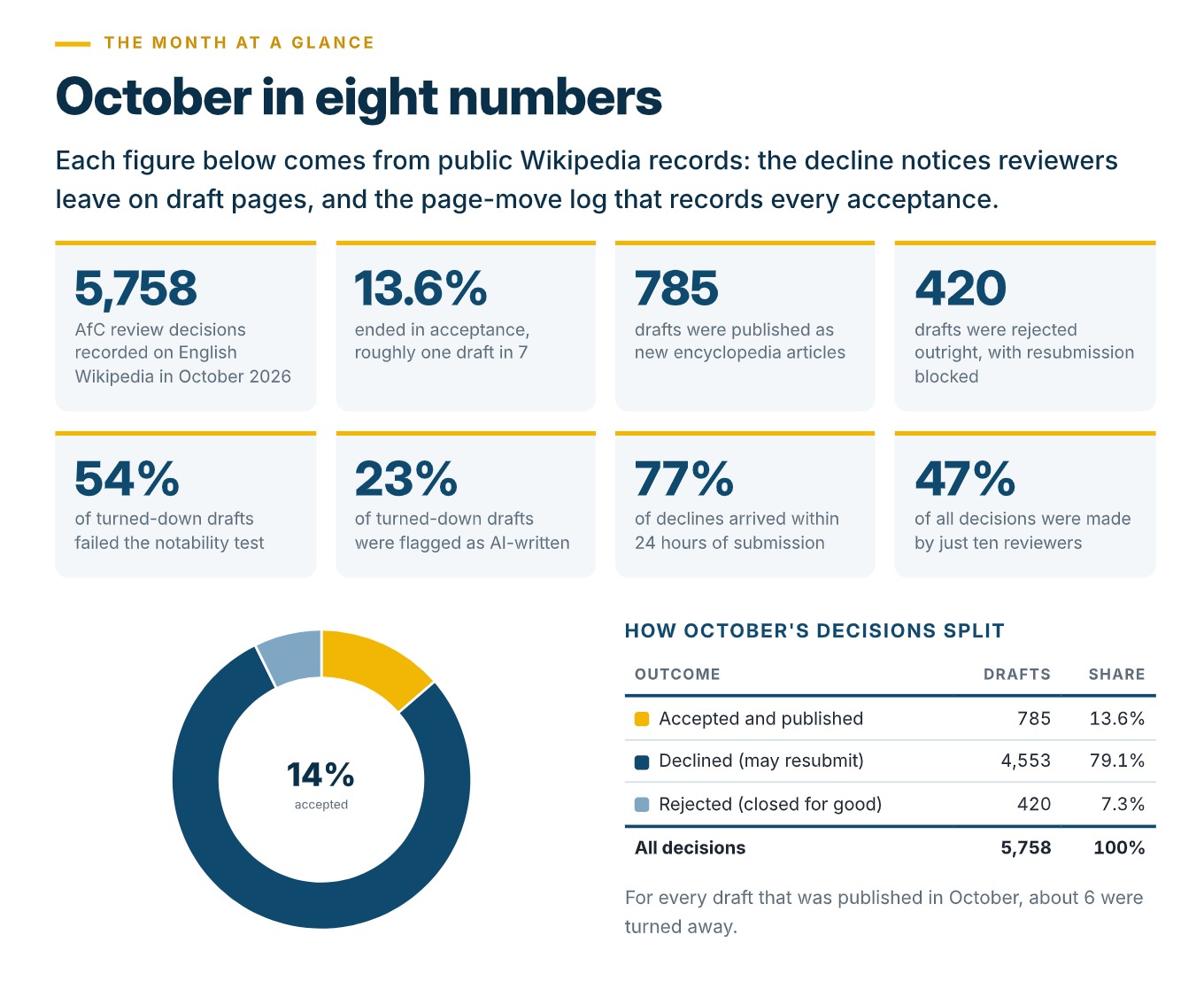
Volunteer reviewers made 5,758 decisions in October. Only 785 drafts, or 13.6%, were published as new articles. Another 4,553 were declined and sent back for changes, and 420 were rejected outright, meaning they cannot be resubmitted. For every draft that made it into the encyclopedia, about six were turned away.
AI-written drafts are now the top reason for a decline
The most striking finding is the rise of AI. The most common reason reviewers gave for declining a draft was that it appeared to be written by an AI chatbot. They used it on 1,125 drafts, about 23% of all declines and more than any other reason.
Wikipedia’s rules are clear: chatbots may not be used to generate, draft or rewrite article content. Reviewers spot the signs quickly, from generic, upbeat phrasing to citations that do not support the claim or do not exist at all.
This matters because cheap, AI-drafted articles are exactly what many low-cost vendors sell. A flagged draft starts from a position of distrust, and invented sources can hurt a subject’s credibility on every later attempt.
Notability is still the biggest wall
Notability remains the biggest overall hurdle. 54% of turned-down drafts were told the subject had not been shown to be notable. Biographies and company pages were hit hardest.
On Wikipedia, notability is not about how successful or important a subject is. It is about whether independent, reliable publications have written about the subject in depth. Press releases, sponsored posts, interviews and a company’s own website do not count. If that coverage does not exist yet, no amount of rewriting will save the draft.
A “no” usually comes fast
77% of declines arrived within a day of submission, and 43% within the first hour. Drafts with obvious problems, such as missing sources, promotional language or AI text, are closed almost as soon as they are seen. A fast decline means the problem was visible on the first read, which also means it was avoidable.
How long do approved drafts wait?
Accepted drafts waited an average of 8.3 days after their last submission, but the median was just 0.6 days. That gap tells the story: 55% of approvals came the same day, while a minority of borderline drafts sat in the queue for weeks. A well-sourced draft about a clearly notable subject is easy to approve, so reviewers move it quickly.
What this means if you want a Wikipedia page
The drafts that got through did not win on polish. They won on proof. Before anyone writes a word, ask: which three independent publications have covered this subject in depth? If the answer is none, the next step is earning press coverage, not drafting an article.
If the coverage is there, give your draft its best chance:
- Have a person write it, not a chatbot.
- Lead with your strongest independent sources and cite every claim.
- Keep the tone neutral, with no marketing language.
- Disclose any paid or personal connection, as Wikipedia requires.
- If declined, fix the specific problem the reviewer named before resubmitting.
And be wary of anyone who guarantees a published page. Wikipedia’s editors are independent volunteers, and no outside firm controls their decisions.
Get the full report and expert help
The complete report goes deeper, with daily review volumes, a full breakdown of decline and rejection reasons, approval wait times and an eight-point pre-submission checklist. [Download the full report here.]
Reputation Stars, a division of Submit Express, has served more than 5,000 clients since 1998. Our experienced Wikipedia editors start with an honest notability assessment and follow Wikipedia’s paid-editing disclosure rules. If your subject is not notable yet, our PR team can help you earn the coverage that supports a future article.
Thinking about a Wikipedia page, or stuck with a declined draft? Call us at (818) 526-0404 or contact Reputation Stars today to talk through your options.
